
Desert Edge Opened With a Shutout. Henri MacArthur Talks Film, Defense and Roskopf's Expanded Role.
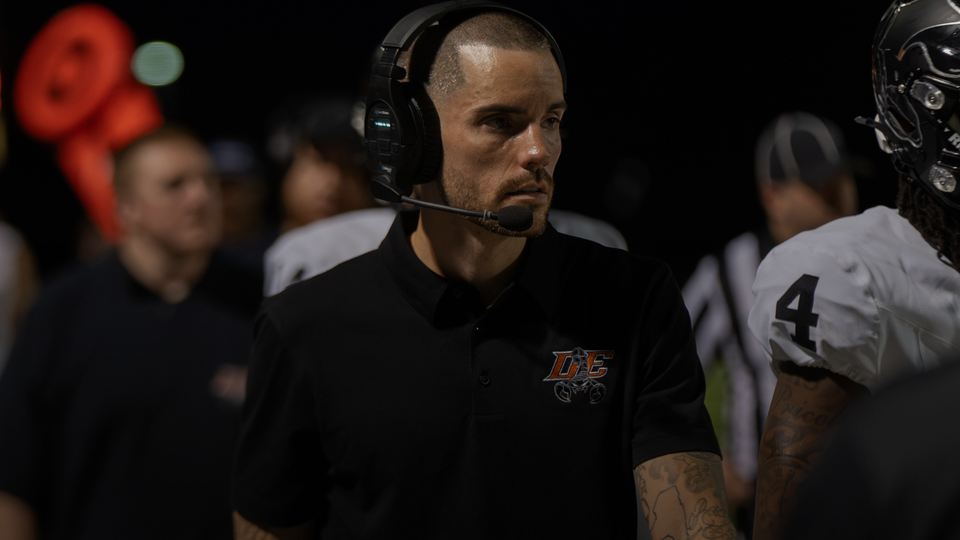
416 passing yards. 24 rushing yards. 89 defensive snaps. Zero points allowed. Desert Edge's third-year head coach went through all of it, including the number that bothered him most.
Desert Edge does not need an introduction in Arizona anymore. Henri MacArthur took the job in the summer of 2024 after nearly a decade as an assistant in the building, inherited a program in the middle of a leadership change, watched his team start slowly, and had a 5A state championship by December. That is not a fluke résumé. That is a coach who knows exactly what his program is supposed to look like.
Which is why the way he graded a 20-0 season-opening win at Cactus Shadows tells you more about this team than the final score does.
The Scorpions went to Cave Creek on Aug. 27 and produced 440 total yards. Blake Roskopf, the 6-foot-5 senior committed to Washington, threw for 416 of them with three touchdowns and one interception at 12.2 yards per attempt. The run game accounted for 24 yards. The defense played 89 snaps and did not allow a point.
That last pairing is the number to sit with. Eighty-nine defensive snaps is not a shutout script. A defense that gets off the field on schedule plays 45 to 55. Eighty-nine means the opponent stayed out there, drives kept living, and Desert Edge kept re-huddling. The shutout, in other words, was built as much on stamina as on suffocation and MacArthur, watching the tape back, went straight to the reason the snap count got that high.
THE BOX
- Final: Desert Edge 20, Cactus Shadows 0 (Thursday, Aug. 27 — at Cave Creek, season opener)
- Total offense: 440 yards
- Passing: Blake Roskopf (Sr., QB, 6-5/225, Washington commit) — 416 yards, 3 TD, 1 INT, 12.2 yards per attempt
- Rushing: 24 yards
- Points allowed: 0
- Defensive snaps: 89
- Unsportsmanlike penalties on third down: 3
- Kye Wells: 2 sacks, forced fumble
- Jaelyn Easterling-Flores: 89 of 89 defensive snaps at corner, nickel and safety; sack-fumble
- Treyvon Woods: press man with no help, multiple pass breakups
- Head coach: Henri MacArthur, third season (2024 5A state champion)
Coach, when you went back and watched the film, what stood out most about the way your team played in the 20-0 win?
"What stood out to me was the offensive efficiency — how quick we got the ball out. Blake's decisiveness. I thought he made great decisions all night. Even the one interception he had, I thought it was the right decision. He just didn't put quite enough on the ball. So that's what stood out to me as something we can really carry forward. If we can be that efficient and that decisive as an offense, I think we're going to be scary."
MacArthur's first word was "efficiency," not "explosive," and the numbers back the choice. Roskopf averaged 12.2 yards per attempt on roughly 34 throws. In most offenses, a number that high is a deep-shot number. This one wasn't. By MacArthur's own description the plan was quick game, ball out on time, catch-and-go. Getting to 12.2 that way means the yardage came after the catch, which is a very different film than 416 on eight explosive heaves.
The interception answer is the tell. A head coach who defends a pick as the right read is telling you he coaches process over outcome, and that the quarterback is being evaluated on decision quality rather than the stat line. That distinction matters for a senior with a Power Four commitment who will be under-thrown scrutiny all fall.
A shutout is obviously impressive, but was the defensive performance as dominant on film as the final score suggests? What did you guys do particularly well?
"Our standard on defense is high, so the shutout didn't surprise me. I think we have a lot more to show on defense, actually. Our effort to the ball was great, which is the culture that we've said and that these guys play to, and I'm really proud of that. But execution-wise on defense, and discipline-wise on defense with some of the penalties, we have a lot to clean up."
This is the most revealing answer in the interview, and it is a program-culture answer disguised as a film answer. MacArthur's 2024 championship defense allowed 16 points per game. When a staff has already established that baseline, a shutout is confirmation, not celebration. The phrase "didn't surprise me" is doing real work there.
He separated effort from execution, and graded them differently. Effort to the ball: high. Execution and discipline: unfinished. That is a rare and useful split, because it is the honest read on a Week 1 defense that played 89 snaps. Effort travels from June. Execution does not.
What was the biggest point of emphasis in the game plan against Cactus Shadows, and how well did your players execute it?
"Honestly, the biggest point of emphasis in that game, as well as every game we play, is to focus on us on both sides of the ball — our technique, our reads, our game plan, our execution and our effort. We feel like if we do those things and play to our standard on both sides of the ball, it doesn't really matter who the opponent is. We'll be in a good spot. So we really try to focus on us, and I thought we did some of those things well and some of those things not as well, but a lot of positive things we can carry forward."
"It doesn't really matter who the opponent is" is a coaching philosophy with a real cost and a real payoff. The cost is that you occasionally give up a scheme-specific edge. The payoff is that your team's floor stops moving week to week, which is the single most valuable thing a program with high expectations can own. It also explains the internal grading standard: Desert Edge did not evaluate this game against Cactus Shadows. It evaluated it against Desert Edge.
Who were one or two defensive players whose impact might not necessarily show up in the box score? What did they do that was important to the shutout?
"Three guys stood out to me defensively. Kye Wells — two sacks with the forced fumble. I know you said guys that didn't have stats, but he really played a great game, so I've got to give him a shout out. Treyvon Woods, who stepped up in place of Nekhi Lambeth and played man coverage with no help all night long and had a couple of pass breakups. Really played well for us, so super proud of him. Someone that's been in our program, this is his senior year, getting a chance to impact the game and now taking full advantage of it.
And then Jaelyn Easterling-Flores. He was, I think, the only guy in our defense who played all 89 snaps. So he played every single snap — played corner, played nickel, played safety. Great performance by him. Also had a sack-fumble."
Woods is the answer that actually fits the question. Filling in for Lambeth, a 2028 corner the staff has invested real developmental capital in, and being asked to play man with no help for a full game is the least forgiving assignment in high school football. Two pass breakups is the visible part. The invisible part is what didn't get called at him, and what the opponent stopped throwing after the first quarter.
Easterling-Flores playing 89 of 89 snaps across three different positions is a coordinator's luxury and a projection scout's dream. Corner, nickel and safety in the same game means the staff trusts his communication, not just his athleticism. Positional versatility at that volume, in that heat, in Week 1, is the kind of thing that shows up on college board rooms long before it shows up on Hudl.
Wells' two sacks and a forced fumble is the one line that will make the recruiting rounds, and MacArthur volunteered it even after being asked for the opposite. Take that as a coach refusing to let a stat line go unmentioned because the question was framed narrowly.
When you evaluate defensive football, what are the indicators you look at beyond points allowed — explosive plays, third downs, tackling, turnovers, pressure? How did you grade your group in those areas?
"When I grade it, it starts with effort and pursuit to the football, which I thought we did a really, really good job of. More detail-oriented stuff would be third-down percentage, explosive plays like you said, and I thought we did a really good job at that. I just think we let them off the hook with some badly timed penalties which allowed them to extend drives. We had a roughing the passer on third and long. We had three unsportsmanlike penalties on third downs where they would have ended up punting. So we just allowed them to extend drives off of our own actions. That's been addressed. I think the guys know what to do and what not to do, and we'll be better with that going forward."
Here is where the 89-snap number resolves. Three unsportsmanlike penalties on third downs that would have ended in punts, plus a roughing call on third and long, is four extra series' worth of football that Desert Edge handed back. The defense pitched a shutout while manufacturing its own overtime. That is simultaneously the most encouraging and most concerning thing on the tape.
Note the hierarchy of his grading sheet: effort and pursuit first, then third down, then explosives. Effort is a culture metric. Third down is a scheme-and-discipline metric. Explosives are a personnel metric. MacArthur passed all three and still failed himself on a fourth category he didn't name until the end — self-inflicted damage. Against Cactus Shadows the bill came to zero points. Against a top-tier 5A offense in November, four free series is the game.
The word to hold onto is "addressed." Not "we'll look at it." A staff that treats unsportsmanlike flags as a coachable, correctable, one-time thing usually gets it corrected. A staff that treats them as passion usually doesn't.
Blake threw for over 400 yards. What was he seeing from the defense that allowed you guys to be so productive through the air?
"I think Blake has taken big steps in his understanding of the game — being able to make reads not only pre-snap but post-snap, to know where to go with the football fast. I think that's what allowed him to have such a productive game: his decisiveness of making the right decision, and making it right now. Not waiting to see guys open, not waiting for the big play necessarily. Making the right play every time and letting his guys make some plays after the catch."
"Post-snap" is the operative word in that answer, and it is the hardest jump a high school quarterback makes. Pre-snap identification can be taught by Wednesday. Reading a rotation after the ball is snapped, from a moving platform, with a rush arriving, is the skill that separates high-volume high school passers from quarterbacks who function in a college system. MacArthur is describing the second one.
"Not waiting for the big play" is a scouting note on a 6-5, 225-pound thrower who has the arm to hunt them. Roskopf threw 37 touchdowns to eight interceptions as a junior. The number that matters here is the one he passed up.
How much freedom does Blake have at the line of scrimmage to change protections, identify coverages or get the offense into a better play?
"Blake has a lot of freedom this year. He's involved in the game planning process more than ever. So we're out there running plays that he's been involved with picking for the week. He knows what to look for and he believes in the plays that he's actually running. So he has a lot of freedom and a lot of involvement in what we do. And that's been earned because of his hard work and dedication and film studying, all those types of things."
A high school quarterback helping select the weekly install is unusual, and it changes how you read the 416 yards. Ownership of the call sheet produces exactly the trait MacArthur praised twice: speed of decision. You do not hesitate on a concept you argued for on Tuesday.
It also raises his college projection independent of the arm. Every Power Four staff evaluating a 2027 quarterback is trying to answer one question — can he process, communicate and lead a room. A coach saying "he's in the game-planning process more than ever, and he earned it" is a direct answer to that question, and it will matter to Washington's staff more than the yardage.
You only had 24 rushing yards but still generated 440 total yards. Was throwing the football that heavily part of the plan going in, or was it something the defense dictated?
"A little bit of both. I think their defense did a good job of stopping the run, and I think we're not where we need to be offensively in the run game yet. So that's obviously something we need to work on. But I think we made up for it with a lot of efficient short, quick game where we got the ball out quick, like I said earlier, and got the ball in Jhaheem's hands and Zerek's hands. Those guys were able to make plays after the catch. So I was happy that when the run game didn't work, we had answers. And I do expect our run game to improve as the season goes on."
Twenty-four rushing yards on a night you win by 20 is a stat that cuts both ways, and MacArthur didn't spin it. "We're not where we need to be" is a direct admission from a coach who could easily have hidden behind 440 total yards. That candor is the most useful line in the interview for anyone projecting this team forward.
The real finding is that the answers existed. Losing the run game and still producing 440 yards means the quick-game menu is functional, Jhaheem Brown and Zerek Sidney can create after the catch, and the quarterback can carry a plan by himself. Most Week 1 offenses that get run-stuffed score 10.
What did Blake do in this game that won't necessarily show up when somebody looks at the 416 yards and three touchdowns?
"Really quick decision-making. Not putting the ball in harm's way. Like I said, we had the one pick that he threw, but I thought it was the right read. So just making great decisions all night, taking good care of the ball, taking care of himself, putting his receivers in positions to succeed, putting the O-line in a position to succeed with his decisiveness and getting the ball out quick."
"Putting the O-line in a position to succeed" is the sleeper phrase in this entire interview. A quarterback who gets the ball out on time is functionally a pass-protection scheme. The sack numbers a line posts, the confidence a tackle plays with in the fourth quarter, the willingness of a coordinator to keep five in protection instead of six — all of it traces back to the internal clock. That contribution never appears in a box score and shows up in every other number on the sheet.
"Taking care of himself" is the other one. For a program whose season rests on a Washington-committed senior, availability is the whole ballgame.
There are high expectations surrounding Desert Edge this season. How do you keep your players focused on weekly improvement instead of the championship expectations surrounding the program?
"I think we just have a one-at-a-time mentality. Every week is a Super Bowl. We're not looking, we're not talking about Week 5, we're not talking about Week 7, we're not talking about a region championship. We're not talking about a state championship. We're talking about winning this week. Practicing well every week, being efficient every day in what we do. So I think that's a way that we keep everybody on course. We don't think too much about expectations and rankings and all these things. We're a one-week-at-a-time program."
This is not new messaging from MacArthur, and that consistency is the point. He said a version of the same thing in the spring, framing the weight room as its own state championship. Programs that change their language when the rankings arrive get exposed. Programs that were already saying it in March tend to hold.
What do you want the identity of this 2026 Desert Edge team to become?
"Identity — just hard workers. Guys that play hard and play to their maximum ability and maximum effort, and play with strain, as I would call it. Strain to the ball, strain when they're blocking. Everything we do has to be with high effort. And I think if we do that, with as hard as we've worked and as talented as we are and as skilled as we are, we will be where we want to be when that time comes."
"Strain" is the word to write down. It is a coaching term, not a media term, and it means the visible physical effort at the end of a rep — the last two yards of a pursuit angle, the finish on a block after the whistle is coming. It is also the one thing on a defensive tape you cannot fake, cannot scheme and cannot recruit. MacArthur named it before he named talent, and he named talent third.
How different is this team's personality from the group that won the 2024 state championship?
"Every team is different, so it's hard to compare this group to the 2024 group that won the state championship. But the one thing I would say I see as a similarity is this group is all about winning. They want to win games. They're not worried about articles, they're not worried about rankings, they're not worried about offers. Everybody is all in right now on the team, and being the best team they can be, and winning each week.
That was the same case in 2024, but in 2024 it took a while to get off the ground. I'd say this team is ahead of that team mentality-wise at this juncture in the season. That team, we started out rough, but once we picked it up we got some key transfers back that year, and by the time it counted we were where we needed to be mindset-wise. But it took a while to get there. With this group, I think we're closer to where we need to be mindset-wise this early in the season."
The 2024 comparison holds up against the record. That championship team started slowly and had to build toward the version of itself that won a title. MacArthur is saying this group is already carrying the mindset that one needed October to find, and he said it about a team full of ranked recruits and offer lists — the exact roster profile most likely to be distracted by them.
"They're not worried about articles" said to an interviewer is a small, honest moment. Read it as a coach telling you what he sells in the building every day.
Final Thoughts
The easy version of this story is that Desert Edge opened with a shutout and a 400-yard passer, and the expectations are justified. The film version is more interesting.
What can't be taught here is already visible. The pursuit and effort MacArthur grades first showed up on 89 defensive snaps in the season's opening week. A senior corner asked to play man with no help for a full game did it. A defensive back played every single defensive snap across three positions and forced a fumble. That is a roster that is conditioned, coached and willing.
What raises the projection is the quarterback's process, not his production. Roskopf's 12.2 yards per attempt came out of a quick-game plan he helped build, on reads he made after the snap, with one interception his head coach graded as the correct decision. Arm talent was never the question with a 6-5, 225-pound Washington commit. Decision speed was, and this was the answer.
What keeps this from being a coronation is the part MacArthur volunteered himself. Twenty-four rushing yards. Three unsportsmanlike penalties on third downs that would have ended in punts. A roughing call on third and long. A defense that pitched a shutout while extending the opponent's night by four series.
- 20-0 — final score, at Cactus Shadows
- 440 — total yards
- 416 — passing yards, 94.5 percent of the offense
- 12.2 — yards per attempt
- 24 — rushing yards
- 89 — defensive snaps
- 0 — points allowed
- 3 — unsportsmanlike penalties on third downs that would have ended drives
- 16 — points per game allowed by the 2024 state championship defense
Desert Edge won by 20 and its head coach spent the film room on the flags. That is how championship programs open a season.
Comments ()